TheWildland Almanac

The Wildland Almanac

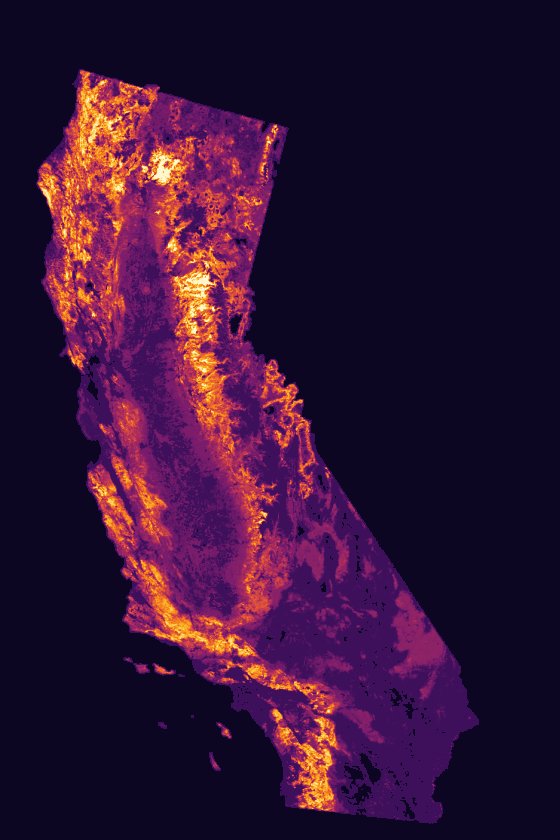
An open, up-to-date set of 30 m rasters for managed and unmanaged forests, shrublands, and grasslands - 41+ years of annual vegetation, carbon, water, fuels, fire hazard, and disturbance. It maps both near-current (2025) conditions and change over time (1985–2025). California is released as annual layers (1985–2025); the contiguous U.S. is now released as decadal snapshots (1990–2025).

CA + CONUS released 30 m 41 years 18 properties CC BY updated annually

An open, frequently-updated, 41+ year GeoTIFF time-series of vegetation, carbon, water, fuels, fire hazard, and disturbance. California (annual, 1985–2025) and the contiguous U.S. (decadal snapshots) are both released now. The Almanac maps California's wildland landscape at 30-m resolution for each year, allowing analyses at local to CONUS scales of near-current conditions and change over time. Each property is expressed in physical units that are consistent with metrics already in common use across the management and research communities. The properties are all calculated from the ground floor up with a unified pipeline; this maximizes consistency between properties and over time.

The dataset is intended for a range of applications, including decision making that benefits from local-scale, near-current information, and research focused on large-scale, long-term trajectories. It was produced by university scientists and is shared freely under CC BY.

What's special here

The Almanac offers five advantages that make it easy to explore and put to use.

  1. Free and open, with nothing in the way

    Available under a CC BY license with no registration required. You can begin exploring and using the data immediately.

  2. A four-dimensional data cube with a broad collection of properties

    Eighteen properties at 30 m resolution, fine enough for local planning, and expansive enough for large-scale analyses that are not possible with most other datasets. Built on the Landsat record, it retains a 41-year annual cadence and high temporal precision, including analyzing change over years and decades, or exploring the quantitative tradeoffs between multiple properties.

  3. Temporal precision across four decades

    The pipeline maximizes consistency through time while maintaining high spatial accuracy within each year. The result is a continuous 41-year annual record of properties such as canopy cover and biomass that, to our knowledge, no other dataset offers - opening up analyses that are otherwise out of reach, including tracking disturbance intensity and recovery year by year.

  4. Just the beginning

    The California release is now joined by selected snapshot years for CONUS. The processing pipeline is built for rapid, efficient updates and steady improvements with each release: a release through water year 2026 (Oct-Sep) is expected in early 2027, and your feedback helps shape them. Work is underway to add further properties and forward-looking projections, including how conditions change under disturbance and management scenarios.

  5. Cloud-native, and easy to adopt

    Built for the modern cloud-native geospatial ecosystem and easy to fold into existing ArcGIS, QGIS, or Python workflows. The data are served from Source Cooperative as Cloud-Optimized GeoTIFFs. You don't need to download anything. Stream the files directly into the software you already use. The goal is to make adoption and use as efficient as possible.

The Almanac grows out of the Center for Ecosystem Climate Solutions (CECS), a four-year, ~$5M California program involving more than twenty university scientists, which led to dozens of peer-reviewed publications and whose datasets have been used by dozens of land-management entities. More about the project and its history →

What it covers

The Almanac maps the vegetated, non-irrigated land surface of California - and the contiguous U.S. - managed and unmanaged forests, shrublands, and grasslands, from the backcountry to the wildland–urban interface. The data are produced wall‑to‑wall and then masked to exclude areas such as open water, urbanized land, and intensively managed cropland.

The dataset includes wilderness, intermix and interface areas, managed forests and plantations, and stands recently thinned, cut, or burned.

Eighteen properties, six themes

Each property and year is a separate 30 m Cloud-Optimized GeoTIFF, which are expressed in physical units and parallel metrics that are already in common use.

ThemeLayersCoverage
Vegetation cover & structure 4 layers Fractional cover - tree, shrub, herbaceous, and bare. Canopy height is now a band of the fire landscape.
Hydrology 5 layers Actual and maximum evapotranspiration, soil moisture, runoff, and vegetation-driven water yield.
Fire hazard 3 layers Landscape fuels (a FARSITE/FlamMap landscape, delivered as single-band layers) and FlamMap-modeled flame length and rate of spread.
Carbon sequestration 2 layers Aboveground live biomass and gross primary production - relevant to nature-based climate solutions.
Forest dieoff risk 1 layer Tree-canopy vulnerability under severe long-term drought (48-month SPI = −2).
Disturbance severity 3 layers Observed pixel-level loss of tree cover, shrub cover, and aboveground biomass.

See full layer details, units, and caveats →

Explore